Table of Contents
ToggleThat spare bedroom collecting dust and seasonal storage is prime real estate for a home gym. Unlike a commercial fitness facility with unlimited square footage, your at-home setup needs strategy, the right mix of equipment, smart storage, and design choices that keep you motivated to actually use it. This guide walks you through assessing your space, selecting functional equipment, and creating a gym that fits your goals and room dimensions. You’ll cover everything from flooring and mirrors to lighting and layout, so you can build a space that works as hard as you do.
Key Takeaways
- Measure your spare bedroom’s floor area, ceiling height, and obstacles before selecting equipment—most spare bedrooms (100–200 square feet) are workable for a home gym with proper planning.
- Align equipment choices with your fitness goals: cardio machines need 6×3 feet of space, while strength training with dumbbells and kettlebells uses less footprint and suits smaller rooms.
- Interlocking foam tiles or rubber flooring ($40–$80 for 4×6 feet) protects your investment and absorbs sound and shock better than standard bedroom carpet.
- Install cool-toned LED lighting (4000K–5000K) and mirrors (36+ inches wide) to boost energy, prevent form errors, and make your space feel intentional rather than like a storage area.
- A spare bedroom gym thrives on organization—use wall-mounted storage, cable management, and one designated rest zone—so you’ll actually use it consistently instead of letting it collect dust.
Assess Your Space and Set Your Fitness Goals
Before buying a single dumbbell, measure your room. Grab a tape measure and write down the floor area in square feet, ceiling height, and note any obstacles like closets, windows, or HVAC vents. A typical spare bedroom runs 100–200 square feet, which is workable for most home gyms, but those dimensions dictate what equipment fits and how you’ll arrange it.
Next, clarify your goals. Are you training for strength, cardio endurance, flexibility, or a mix? Someone doing barbell work needs a different setup than someone focused on yoga and lightweight resistance. A CrossFit-style program requires open floor space: a weight machine setup needs less room but takes up more of it. Your goals also inform flooring choices (shock-absorbent for jumping, basic plywood for light strength work) and equipment priorities.
Check your budget too. Home gyms can start under $500 with resistance bands and a mat, or run into thousands with commercial-grade equipment. Be honest about what you’ll use consistently. A $2,000 treadmill gathers dust faster than a $50 jump rope if your actual preference is cardio variety.
Choose the Right Equipment for Your Room Size
Cardio Equipment vs. Strength Training Setup
Cardio machines eat space. A treadmill or rowing machine claims roughly 6 feet long by 3 feet wide, and you need clearance on the sides and behind for safety. If your bedroom is tight, cardio might mean a jump rope, resistance bands, or bodyweight circuits, not a machine. Conversely, strength training with dumbbells, kettlebells, or a weight rack concentrates intensity into less footprint. A squat rack with weights occupies about 4 feet by 4 feet, but delivers full-body strength work.
Mid-range options bridge the gap. An adjustable dumbbell set (5–50 lbs) handles upper and lower body work in minimal space. Resistance bands and suspension trainers (like TRX-style systems) weigh almost nothing and use wall or door anchors. A weight bench with adjustable incline adds versatility without massive floor commitment.
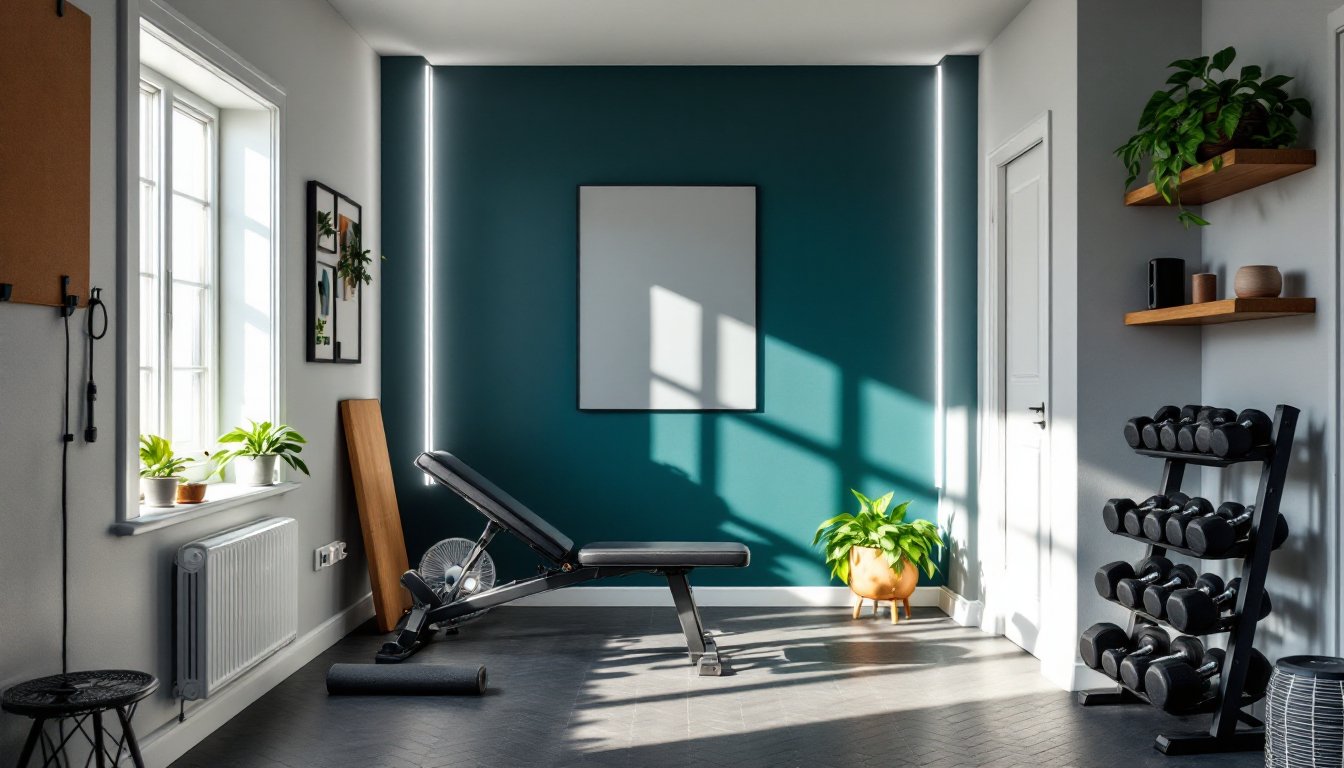
For small spaces under 100 square feet, skip the cardio machine and stack equipment: one compact bench, a dumbbell rack, a pull-up bar mounted in the doorframe, and a yoga mat. That covers strength, pull-ups, and flexibility in about 50 square feet. For larger rooms, a rower or stationary bike becomes viable alongside free weights.
Create a Functional Layout and Storage Plan
Layout matters as much as equipment choice. Sketch a floor plan on paper or use a free tool like Floorplanner. Place larger equipment (bench, rack, cardio) along walls to keep the center open for movement. Arrange mirrors opposite windows to bounce natural light and create depth, making the room feel larger.
Storage keeps the space functional and safe. Wall-mounted shelves hold lighter items like foam rollers, resistance bands, and towels. Dumbbells go into a compact rack (not scattered on the floor, trip hazard). A closet rod can hang jump ropes, belts, or suspension trainers vertically. If the closet still has hanging space, use those shelves for shoes, gear, and cleaning supplies.
Cable management matters too. If you’re running a stationary bike or treadmill, route the power cord along the baseboards and secure it with clips or ties. A small power strip mounted safely on the wall keeps devices charged without creating a fire hazard. Designate one corner as your “rest and recovery” zone with a foam roller and mat, it signals purpose and keeps the room organized.
Design Your Gym With Flooring, Lighting, and Mirrors
Flooring sets the tone for comfort and equipment protection. Standard bedroom carpet doesn’t cut it: sweat, dropped weights, and vibration from equipment wear it out and leave permanent marks. Interlocking foam tiles (rubber or EVA foam, typically 3/8 inch thick) offer shock absorption, noise reduction, and easy cleaning. They cost $40–$80 for a 4×6 area and come in colors that coordinate with your décor. Alternatively, rubber rolls ($2–4 per square foot) provide durability under barbells and machines, though they’re harder to install than tiles.
For a tighter budget, lay plywood sheets down first, then cover with a heavy-duty yoga mat or rubber underlay. It’s a fraction of the cost of commercial flooring and works for light to moderate use. Just acclimate the plywood to the room’s humidity for a few days before installing, solid wood can cup or warp if humidity changes suddenly.
Lighting transforms the energy. Overhead ceiling fixtures cast shadows: add task lighting with wall sconces or LED strips along upper walls. Bright, cool-toned LEDs (4000K–5000K color temperature) boost focus and energy, unlike warm home lighting that feels cozy but sleepy. Position mirrors (36 inches wide minimum) opposite the equipment area so you can check form without turning your head, form accuracy prevents injury.
Ventilation and temperature matter too. A small oscillating fan ($20–40) keeps air moving: a window open while working out helps. Humidity control prevents rust on equipment, if your region is damp, a dehumidifier earns its spot.
Make It Inviting: Décor and Motivation Elements
Your home gym competes with your couch, so the space needs personality. Paint the walls a single accent color, deep greens, grays, or navy create focus without visual clutter. Keep trim and baseboards neutral. A fresh coat of paint costs $100–200 and shifts the whole feel from “storage closet” to “intentional space.”
Add motivational cues without overdoing it. One inspirational quote or a printed performance chart keeps purpose visible. A whiteboard tracks workouts and PRs (personal records). A small bluetooth speaker (or wall-mounted speaker) plays music or guided workouts, sound matters more than most people realize for consistency. Spotify, Apple Music, or YouTube have thousands of workout playlists.
Plants add life without fuss. A pothos or snake plant tolerates low light and humidity swings: place one on a shelf or in a corner. They improve air quality and signal care for your space. Recent studies on home design show that natural elements, even a single plant, increase perceived spaciousness and workout adherence.
Fit your décor to the room’s purpose. If your home gym doubles as a guest room, keep equipment in closed storage (a cabinet or armoire) and decor minimal so the space shifts between roles. If it’s dedicated, go bolder, let the gym dominate. This isn’t a showroom: it’s your training ground. Designers at Young House Love and The Spruce regularly tackle spare room makeovers with budget-friendly, functional approaches that balance style and practical use.
Conclusion
A spare bedroom gym doesn’t require architectural changes or a five-figure budget. Start with an honest assessment of your space and fitness goals, choose equipment that matches both, then layer in smart storage, functional flooring, and lighting that energizes. When your gym feels intentional, organized, well-lit, and aligned with your actual training style, you’ll use it. The best gym is the one you walk into consistently, and that happens when the space works with you, not against you. ImproveNet’s renovation guides offer cost breakdowns for various home improvement projects if you’re budgeting larger design upgrades.